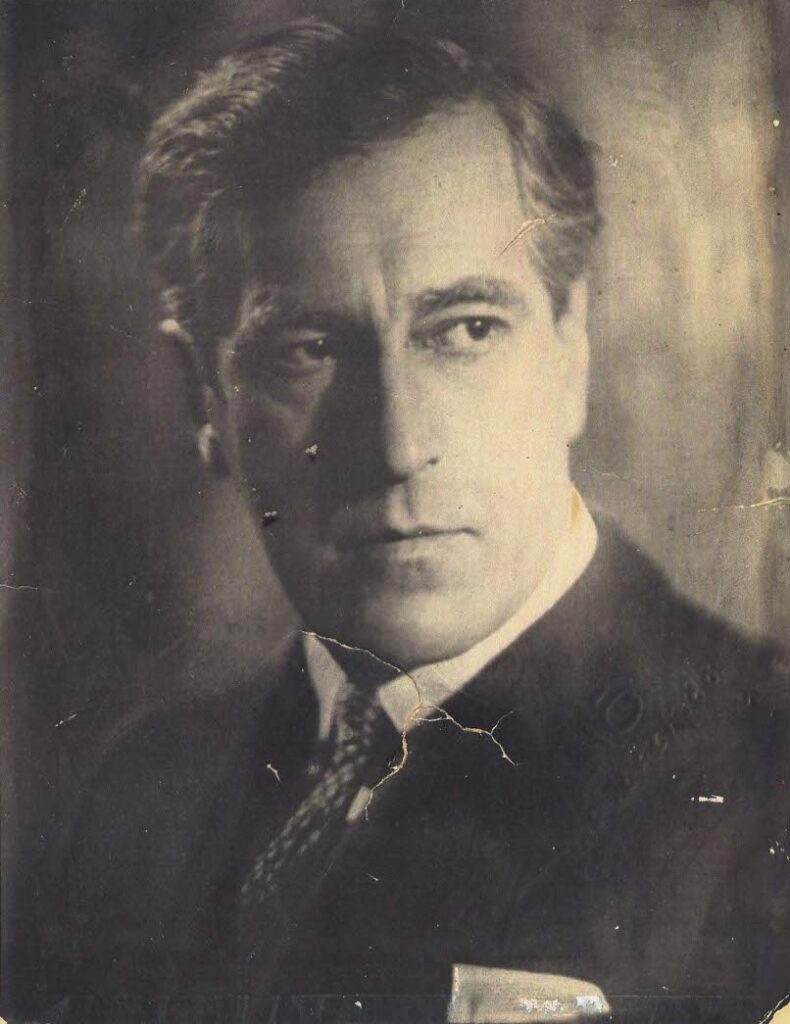
Pawel Lewiecki 1896-1974
BIO FROM WIKIPEDIA
Pawel Lewiecki, a Polish pianist, was born on 8 May 1896 in Nalczyk (the Caucasus) and died on 21 August 1974 in Warsaw. He began music lessons at the age of four, and by the age of six he was showing off at his aunt’s salons in St. Petersburg. He completed a music school in Kishinev, and next the Moscow Conservatory under Konstanty Igumnov and Alexander Scriabin. At his diploma concert, in 1917, he played the Rachmaninoff Concerto in F sharp minor reading first-edited copies of the composer’s notes, whom he knew from meetings at aristocracy’s. He also studied law at the Moscow University. In 1917 he was incorporated into the Tzar’s army fighting Bolshevism. Upon the savage murders committed by Bolshevik soldiers on some of his family members, he escaped Russia with those who had survived, and through Besarabia and Turkey he reached Paris. There, in 1919, he obtained new documents with which he could return to Poland. He made his debut in Biała Podlaska with three recitals in 1920. In the following year he played in Warsaw for the first time, which resulted in invitations for him to perform in other cities and again in Warsaw. After the Warsaw recital, a critic wrote: “Lewiecki instantly sketched himself as a virtuoso of an extraordinary scale. The artist’s pianistic means are versatile, the tone is huge and vibrant, the technique well-adjusted and accomplished, and the force enormous. […] Personal spiritual awareness is incredible, the artist has a real sense of music and his instrument, and he can reach the deepest levels of a work, being able to exercise restraint on his fiery temperament.” Between the world wars he widely toured in the Czech lands, France and Poland, promoting works by contemporary Polish composers, such as Paderewski, Różycki, Szałowski, Szeligowski, Maciejewski, Szymanowski, Feliks Łabuński, Sołtys, Statkowski or Friedman, as well as foreign ones, such as Bartók, Koreshchenko, Arensky, Lyadov, Lyapunov, Scriabin, Prokofiev and Rachmaninoff, and in many cases he was their first interpreter in Poland. He was involved in concerts organized outside big music centers by Ruch Muzyczny (Musical Movement). He performed with singers, including Aniela Szlemińska. In 1924 Henryk Melcer offered him to head the piano department at the Warsaw Conservatory, which he did until the outbreak of the Second World War. The war found him giving concerts in the east of the country. As soon as he returned to Warsaw, on 11 November, he was arrested by the Gestapo and jailed at the Pawiak prison. After the intervention of Cardinal Adam Stefan Sapieha, he was released in March 1940. During the Nazi occupation, he gave underground concerts of Polish music and taught piano classes privately and at the Conservatory, which continued to exist under the name Staatliche Musikschule in Warschau. After the war he became a professor at The Higher State School of Music in Warsaw. In 1949 to celebrate the centenary of Chopin’s death, he gave a cycle of Chopin recitals and took part in the famous festival “Żywe wydanie dzieł Fryderyka Chopina” (“The Live Edition of Chopin Works”) in Warsaw. His pupils included: Jadwiga Szamotulska, Wanda Łosakiewicz, Janina Garztecka, Józef Kański, Janusz Mechanisz, Wanda Lehrówna, Ken Sasaki.
https://bn.org.pl/chopin/index.php/en/pianists/bio/17
Memories of Boguslaw Kaczynski of Pawel Lewiecki in the book published…
References notes from (Author – Boguslaw Kaczynski “Wielka Slawa to Zart “Page 33 – Page 34
I was collecting the materials for this CD for many months in the hope that it will preserve the pianistic accomplishments of Pawel Lewiecki: that excellent, sensitive artist whose life tried so sorely. He was my professor, my protector and my first guide in the world of art. He showed a great, unconcealed fondness for me, and our relationship resembled that of a father and son. When I first entered his flat in the annex to an old apartment house in Krucza Street, Warsaw, I was but a humble 16-year-old from a little town on the eastern frontier, while he was a great pianist and distinguished teacher, a P. Tchaikovsky Conservatory graduate (Moscow), pupil of Alexander Scriabin and the legendary professor Constantin Igumnov.
By that time, Lewiecki already appeared as a grey-haired maestro, but despite his age he preserved his good looks, haughtiness, aristocratic manners and old-style elegance. Always in a bow tie rather than a tie, he spoke with a melodious St. Petersburg accent. He was a direct descendant of the Georgian princes of the Mdivani family…well chosen ……….reference . His mother was the Tsarina’s lady-in-waiting, his father – a lawyer, professor of the St. Petersburg University. Pawel Lewiecki had an incredible story-telling talent. Still vivid in my mind are his memories of the Tzar’s court, details of the struggle of enlightened personalities with the influence of Rasputin (the professor had known him in person!) and the moving story of that demonic priest’s assassination by Duke Yusupov – the Professor’s contemporary and a good friend.
A little while later, with the outbreak of the Bolshevist Revolution, the world in which the Professor had lived and developed his talent fell apart. What followed was a struggle for survival, wandering and attempts to escape from burning Russia. This time, fate was on his side. Through Besarabia, the Black Sea and Turkey, he managed to reach Paris, where his aristocratic aunt lived.
He came to Poland in 1922, after the end of the Polish-Soviet war. He was immediately recognized as an extremely talented virtuoso, descending from the magnificent Russian piano school. He won great successes in concert halls, both in Poland and in many European metropolises. In 1924 he accepted the post of professor in Warsaw Conservatory (now the Music Academy), which he held until his death.
Pawel Lewiecki was a man of all-round education, warm, kind, and extremely modest. The experiences of his life (the death of his closest family and friends in revolutionary Russia, the death cell experience in the German Pawiak prison in 1943) he shunned the sham and glitter of life, and useless and common publicity. He concentrated on music, which was his passion and gave meaning to his life. There were also the women, whom he adored and conquered with a truly Southern temperament, at times stirring a sensation in society.
He played an immense repertoire, including nearly all the great classics of piano composition; he also recorded a little in Poland and abroad. The imposing concert programs in nearly all languages can still be found, but nearly all the radio tapes and records have been destroyed. All that remains are a few trifles recorded for the Polish Radio in the 1950’s and a fragment of a 1954 Chopin recital with the Warsaw Philharmonic.
Can these recordings reflect the full magic and power of Pawel Lewiecki’s piano art? This question is hard to answer for a man who has heard hundreds of the professor’s daring performances of virtuoso pieces by Rachmaninov, Busoni, Liszt, Chopin, Beethoven, both conservatory lessons and on his beloved Bechstein in his private flat.

Music
F. Chopin “Nokturn b-moll / Nocturne in B Flat Minor op 9 no. 1”
F. Chopin “Etiuda f-moll / Etude in F Minor, z cyklu / from the cycle: 3 Nouvelles Etudes op. 36 A”
F. Chopin “Largo Es-dur / Largo in E Flat Major”
F. Chopin “Preludium As-dur / Prelude in A Flat Major”
F. Chopin “Fantasie – Impromptu op. 46”
F. Chopin “Mazurek As-dur / Mazurka in A Flat Major op. posth”
F. Chopin “Mazurek g-moll / Mazurka in G Minor op. 24 no. 1”
F. Chopin “Mazurek C-dur / Mazurka in C Major op. 24 no. 2”
F. Chopin “Mazurek As-dur / Mazurka in A Flat Major op. 24 no. 3”
F. Chopin “Mazurek b-moll / Mazurka in B Minor op. 24 no. 4”
A Koroszczenko “Impromptu As-dur / Impromptu in A Flat Major”
A Scriabin / A. Skrybin “Preludium e-moll / Prelude in E Minor op. 11 no. 4”
S. Rachmaninow / S. Rachmaninov “Etudes-Tableaux g-moll / Etudes-Tableaux in G Minor op. 33 no. 8”
F. Schubert “Sonata-Fantazia G-dur / Sonata-Fantasy in G Major op. 78”
F. Liszt “XI Rapsodia wegierska / Hungarian Rhapsody No. 11”
F. Liszt “Consolation Des-dur nr. 3 / Consolation in D Flat Major no. 3”
S. Prokofiev / S. Prokofiev “3 Visions Fugitives op. 22”
S. Liapunow / S. Lyapunov “Lezghinka”